
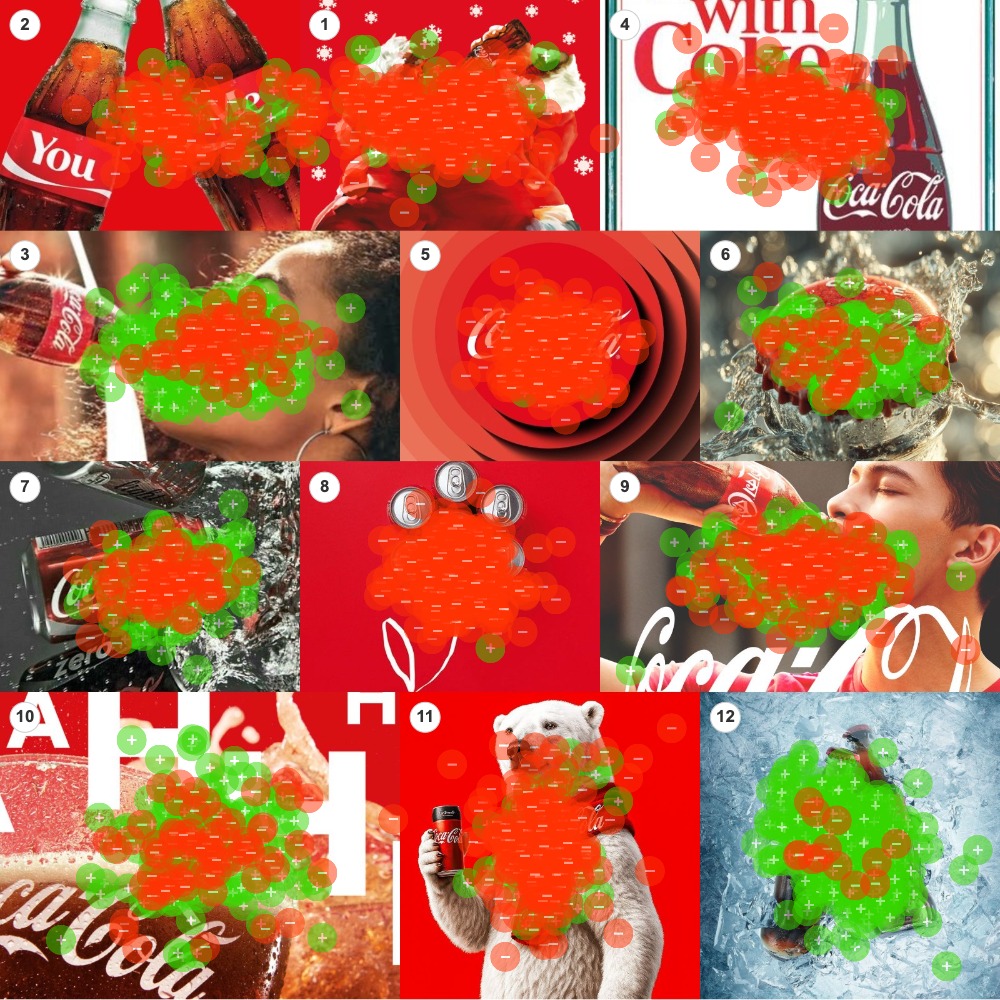
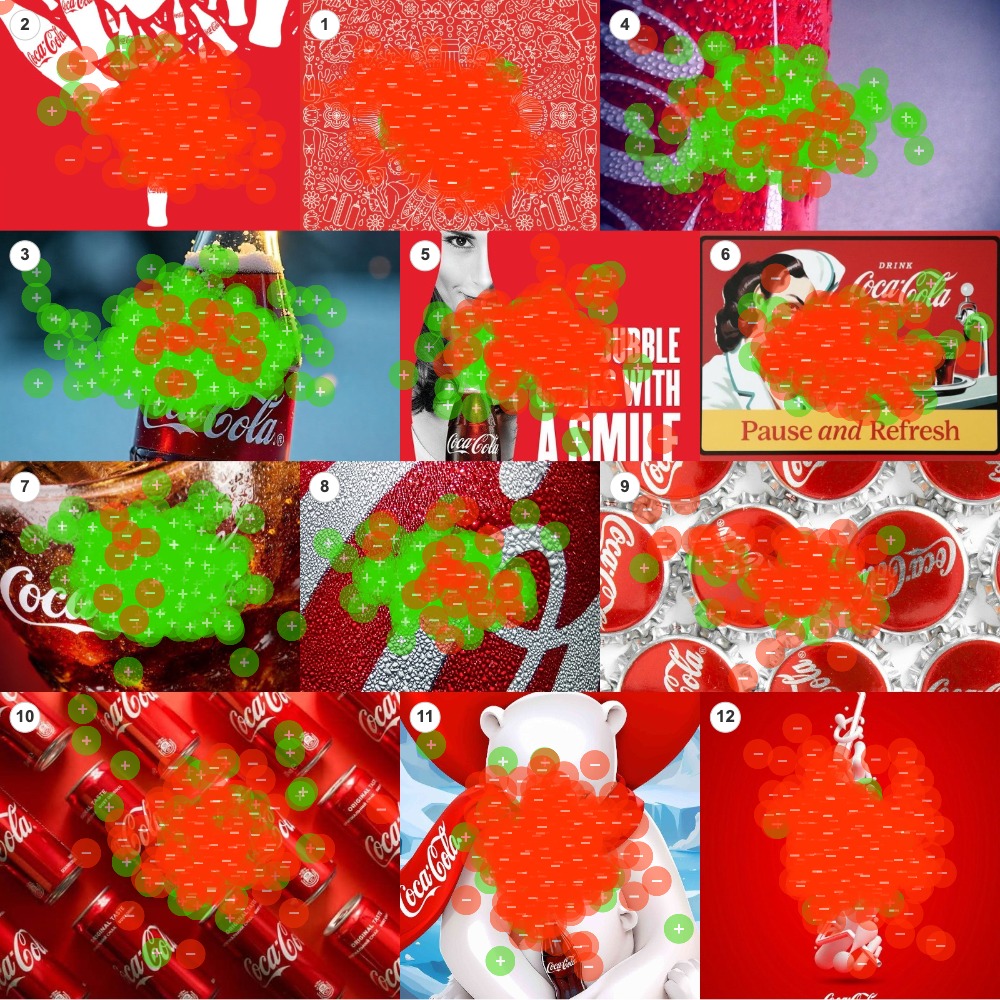
How the study worked
Two boards, twelve images each: product photography, campaign stills, illustration, mascots and graphic design, mixed together with no grouping and no order. 467 people got green dots and red dots and one instruction. Green on the images that make you want a Coca-Cola. Red on the images that do not.
They placed 4,683 dots, 2,331 on Board 1 and 2,352 on Board 2. The point maps above are the raw result before any sorting. The two boards carried different image sets under the same prompt, so the pattern had to appear twice, independently, to count. It did, and the two boards produced structurally identical findings.
At the platform’s 60% threshold the 24 images fall into three groups. Ten cleared the bar as craving triggers, twelve crossed it as craving killers, and two split the room. See the full report for every score. What follows is what each group has in common.
The one variable that decided everything
Line the 24 images up by the share of their dots that came back green and one property sorts them: whether the frame contains visible evidence of cold. Condensation. Ice. Frost. Splashing water. Every image in the resonance array has it. No image in the resistance array has it.
Not the logo. Not a person. Not the contour bottle. The Coca-Cola mark appears on the winners and on the losers. People appear in both. What the winners have that the losers lack is the physical language of a cold drink, rendered close enough to touch.
Figure 1 · Every image, ranked
Principal finding
Participants don’t want to see Coca-Cola’s brand. They want to see Coca-Cola’s drink. Every image that shows cold liquid in contact with a person, or surrounded by ice, scores as a craving trigger. Every image that substitutes storytelling, characters or graphic design for that sensory reality scores as a craving killer. The craving is triggered by perception, not persuasion.
What won: cold, wet and happening now
Ten images cleared the 60% threshold. They share a specific sensory grammar: cold made visible, liquid in motion, and the act of drinking in photographic detail. The two highest scores in the study, 97.58% and 96.47%, are product-only shots with no person, no setting and no narrative. Just ice, condensation and frost in extreme close-up.
The second trigger is the drinker. Both drinking images show a solitary person with eyes closed, and the expression is physical relief, not lifestyle. Participants are responding to the vicarious sensation of drinking, not to social proof of someone enjoying a Coke.
The condensation shot on Board 2 is the most telling result in the array. It shows red metal and water drops, the logo barely legible, and it scored 84.47% green. The texture of cold water on metal triggers craving on its own, without product recognition.
Resonance
The ice-filled glass
Amber liquid, ice and a sweating branded glass in close-up
98% green · 12.29% of the board’s dotsResonance
The bottles in ice
Two glass bottles buried in shattered ice
96% green · 12.14% of the board’s dotsResonance
The frosted bottle
A glass bottle outdoors in snow, ice crystals on the cap
96% green · 12.50% of the board’s dotsResonance
The cap in the splash
A bottle cap hit by water, macro
89% green · 6.74% of the board’s dotsResonance
The beaded label
Extreme macro of a can label under condensation
86% green · 6.29% of the board’s dotsResonance
Condensation alone
Red metal and water drops, the logo barely legible
84% green · 6.85% of the board’s dotsResonance
The drinker, eyes closed
A woman drinking from the bottle, eyes shut
84% green · 11.97% of the board’s dotsResonance
The AHHH glass
Bold type over an ice-filled glass, campaign frame intact
69% green · 7.55% of the board’s dotsResonance
The cans in the splash
Cans tumbling through water on a dark ground
68% green · 6.13% of the board’s dotsResonance
The second drinker
A young man drinking, eyes closed, logo overlaid
64% green · 8.71% of the board’s dotsThe campaign frame costs points
The AHHH image is the outlier that proves the rule. The glass is sweating and the ice is real, but a typographic treatment sits between the viewer and the drink. It scored 68.75%, the weakest result in the array. The concept is good. It costs resonance because it mediates perception through an advertising frame.
What lost: everything the brand has ever done
Twelve images crossed the 60% resistance threshold, three of them above 93%. They span Coca-Cola’s greatest hits: the Santa, the bears, the personalized bottles, the graphic experiments, the logo on its own. What unites them is an absence. None shows cold liquid in a way that feels physically real and immediate.
Mascots displace the product
The illustrated Santa, the photorealistic bear and the hugging CGI bears all fail decisively. This is not a marginal result. When a polar bear is holding the Coke, the attention goes to the bear. The craving circuit is short-circuited by narrative.
Resistance
The hugging bears
Two CGI polar bears, one holding the bottle
82% red · 9.23% of the board’s dotsResistance
The Santa
The illustrated Christmas Santa with a Coke
79% red · 9.40% of the board’s dotsResistance
The AI bear
A photorealistic polar bear in a branded scarf
69% red · 7.68% of the board’s dotsDesign is the wrong register
The flat, abstract and illustrated images are among the most ambitious executions on the boards, and they drew the most unanimous rejection in the study. They fail not because they are bad design but because they are design. Design signals brand, and the participant wants to feel drink.
Resistance
The logo alone
The mark on concentric red circles, nothing else
97% red · 9.01% of the board’s dotsResistance
The type sculpture
An abstract 3D letterform built into a bottle shape
94% red · 9.99% of the board’s dotsResistance
The silhouettes
White bottle outlines multiplying across red
92% red · 8.93% of the board’s dotsResistance
The folk-art bottle
A dense red illustration with decorative motifs
90% red · 10.50% of the board’s dotsConcepts have to be decoded first
The You / Me bottles, the vintage “with Coke” ad and the can balloons are advertising ideas. An idea has to be processed before it can be felt, and the craving trigger is pre-cognitive. Anything that asks the brain to think first loses the window.
Resistance
The can balloons
Cans arranged as a bouquet, flat lay on red
97% red · 9.18% of the board’s dotsResistance
The vintage print ad
A retro “with Coke” layout, bottle in the corner
83% red · 7.94% of the board’s dotsResistance
The You / Me bottles
The personalized-label campaign, two bottles on red
65% red · 3.56% of the board’s dotsAbundance cancels craving
The grid of caps and the diagonal grid of cans show the actual product and still fail. Overhead perspective and hard, even light turn a drink into inventory. You cannot be thirsty looking at a warehouse.
Resistance
The bottle caps
A flat-lay pattern of caps, top down on white
68% red · 3.32% of the board’s dotsResistance
The can grid
A diagonal flat lay of cans, red on red
61% red · 4.85% of the board’s dotsResistance pattern
Anything that mediates between the participant and the physical reality of the drink kills the craving. Characters mediate through narrative. Illustration mediates through style. Campaigns mediate through ideas. Flat lay mediates through aesthetic distance. All of them are legitimate brand tools. None of them make you want a Coke right now.
The whole study in two images
The cleanest pair on the boards is two product-only shots. Neither has a person, a setting or a line of copy. Both are art-directed. One is sweating. The other is arranged.
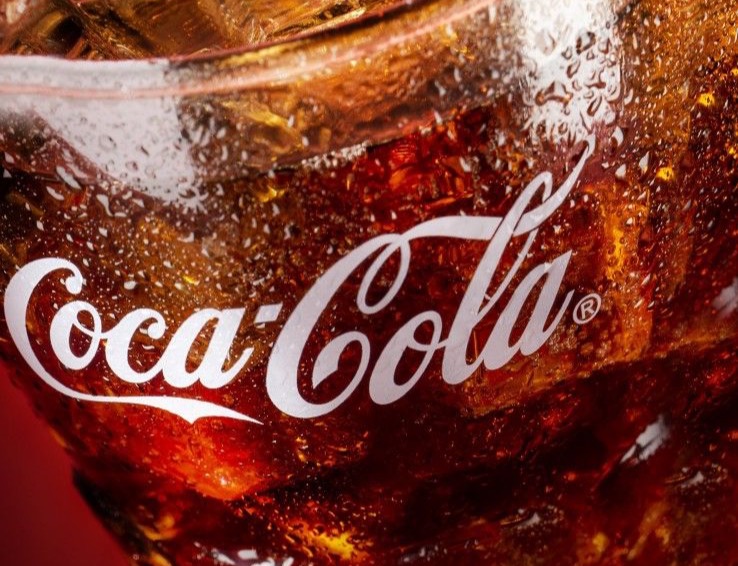
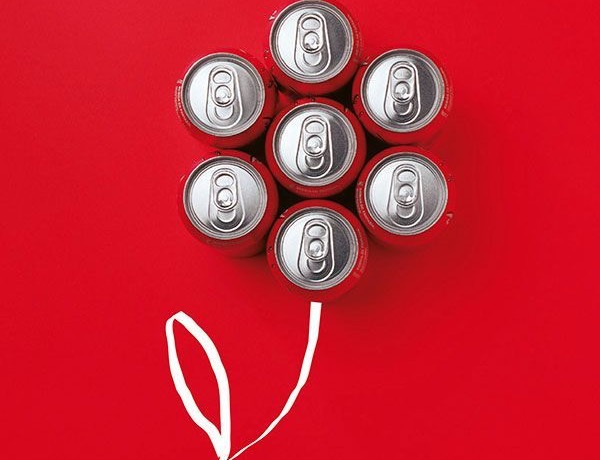
Same product, same red, same absence of people. One is a cold drink. The other is a clever idea about cans, and the room could not have been clearer about which one it wanted.
The two images that split the room
Two images on Board 2 landed below the threshold in both directions, and each contains one craving element inside a resistance frame. The black-and-white woman drinking through a straw has a person drinking, which the winners reward, but the bottle-shaped mask, the monochrome and the tagline reframe a sensation as a claim. The soda-fountain waitress is the closest split in the dataset. Real glasses of Coke pull toward green. The nostalgic illustration pulls toward red. The room divided almost exactly in half.
Contested
The soda-fountain waitress
A vintage illustration presenting real glasses of Coke
52% split · 51.58% green, 48.42% redContested
The bottle-shaped drinker
Black-and-white photo masked into a bottle, tagline on red
40% split · 40.24% green, 59.76% redThe neutrals confirm the model. Sensory content creates pull. Artistic or conceptual framing creates drag. An image that does both lands in the middle.
What to do with this
The decision logic translates directly into art direction, for a soft drink and for any category where the brief is immediate desire rather than long-term affection.
Do
- Lead with cold. Condensation on a can or bottle is the most reliable trigger in the dataset. Frost, ice and splashing water do the same work.
- Shoot the real thing. Photographic realism beat illustration, CGI and graphic design every time. The closer the image sits to what the product looks like, the better it scored.
- Show the act of drinking. A solitary drinker, eyes closed, in physical relief. Not a lifestyle moment, not a social scene.
- Let the liquid show. The amber-brown of the drink appears in nearly every winner and vanishes from the losers.
- Get close. Macro and extreme close-up beat wide shots. Distance kills craving.
Don’t
- Don’t send the mascots. Santa and the bears build brand love. They scored 78.54% and 81.57% red on craving.
- Don’t shoot flat lay. Overhead perspective removes the three-dimensional, light-catching wetness that makes cold appetizing. The can balloons went 97.20% red.
- Don’t lead with the logo. The logo-only lockup scored 96.67% red. The mark alone generates active rejection of craving.
- Don’t make people decode. If the concept takes more than half a second, the window has closed. The You / Me bottles are a clever campaign. They do not make people want a Coke.
- Don’t go nostalgic. Craving is present tense. Retro reads as past: 82.70% red for the vintage print ad.
Craving is not brand love
This study measured one outcome: the desire to drink a Coke right now. It did not measure affinity, purchase intent or loyalty. The bears, the Santa and the graphic campaigns are almost certainly doing their job on those metrics. They just should not be the creative answer when the brief is to make someone thirsty.
Methodology and confidence
467 completions across two boards, 4,683 dot placements over 24 images, 2,331 on Board 1 and 2,352 on Board 2, classified at the platform’s 60% threshold. Several images cleared 90% to 97%, which is near-unanimous consensus rather than a marginal pattern, and the core finding replicates on both boards independently with partially overlapping image sets.
No demographic breakdown was collected, so it is unknown whether age, culture or relationship to the brand modulates the result. The seasonal imagery may perform differently with audiences for whom Santa and the bears are deeply nostalgic. The photorealistic AI bear at 69.27% red is one data point about uncanny mascots, not a verdict on AI imagery.
Frequently asked questions
What was tested in the Coca-Cola craving study?
24 Coca-Cola images across two boards of twelve: product photography, campaign stills, mascots, illustration and graphic design. 467 participants placed green dots on the images that made them want a Coke right now and red dots on the images that did not, 4,683 dots in total, sorted at a 60% threshold.
What does “97.58% green” actually mean?
It means 97.58% of the dots placed on that image were green rather than red. The figure is a share of that image’s own crowd, not a share of all 467 participants. The report also gives each image’s share of its board’s attention: the ice-filled glass drew 12.29% of every dot placed on Board 2, and almost all of them were green.
How do I read the point maps?
Each green mark is one participant saying this image makes me want a Coca-Cola. Each red mark is the opposite. Dense clusters are attention; the colour of the cluster is the verdict. A big red crowd, like the one on the polar bear, means the image stopped people and then lost them.
Does this mean Santa and the polar bears are bad advertising?
No. The study measured one narrow response, the visual trigger of a craving in the moment of viewing. It did not measure recall, affinity or purchase intent, and the mascots are almost certainly strong on those. The finding is that they do not make people thirsty, so they should not be the creative answer when that is the brief.
What does this mean for my brand?
If the goal is immediate desire, at point of sale, in a fridge cling or a social ad, lead with the sensory reality of the product and keep the brand secondary. If the goal is warmth and recognition, the storytelling assets still earn their keep. Run the two briefs as two tests, because the same 467 people will sort the same images differently.